


Weld overlay: a comprehensive guide to the process
On this page we will delve into:
- What is a weld overlay
- How the weld overlay process works
- Types of weld overlay processes
- Why is weld overlay used in industrial components?
- Industries and typical applications
- Materials used for weld overlay
- Weld overlay vs cladding: key differences
- Why partner with MEGA
What is weld overlay
Weld overlay is a specialized surface engineering technique that deposits a layer of corrosion- or wear-resistant material onto the surface of a base component. The process involves applying a protective metal layer through welding, creating a metallurgically bonded coating that enhances the performance and durability of the underlying material.
This technology is widely used in heavy industrial sectors where piping components, flanges, and forged fittings are exposed to aggressive environments, including high temperatures, corrosive fluids, and abrasive particles.
Instead of manufacturing the entire component from expensive corrosion-resistant alloys, weld overlay enables the use of a strong structural base material, such as carbon steel or low-alloy steel, while protecting the surface with a high-performance alloy.
The result is a corrosion-resistant weld metal overlay that combines:
- the mechanical strength of the base material
- the corrosion resistance of the overlay alloy
- significantly lower production costs
For critical piping components such as pipes, flanges, fittings and forgings, weld overlay ensures reliable operation in demanding environments while optimizing material usage and manufacturing efficiency.
How the weld overlay process works
The weld overlay process consists of depositing a filler alloy onto the surface of a base metal via controlled welding. During the process, the filler material melts and fuses with the base metal, forming a metallurgical bond.
The procedure typically includes the following steps:
- Surface preparation - The base component is cleaned and prepared to remove contaminants, scale, or oxides.
- Pre-heating (when required) - Some materials require controlled preheating to reduce thermal stresses and prevent cracking.
- Deposition of the overlay material - A welding torch deposits the filler alloy onto the base metal surface.
- Layer control and dilution management - Multiple layers may be applied to achieve the desired thickness while minimizing dilution with the base metal.
- Post-weld inspection and testing - Non-destructive testing (NDT), ultrasonic inspection, and metallographic analysis verify the quality of the weld overlay.
Modern automated systems ensure precise control of parameters such as:
- heat input
- deposition rate
- dilution level
- overlay thickness
These controls are essential to ensure consistent mechanical and corrosion resistance properties.
Need a weld overlay solution for your project?
Our engineers can support you in selecting the right corrosion-resistant alloy and welding process for your piping components, including pipes, fittings, flanges, and forgings.
Types of weld cladding overlay
Horizontal cladding
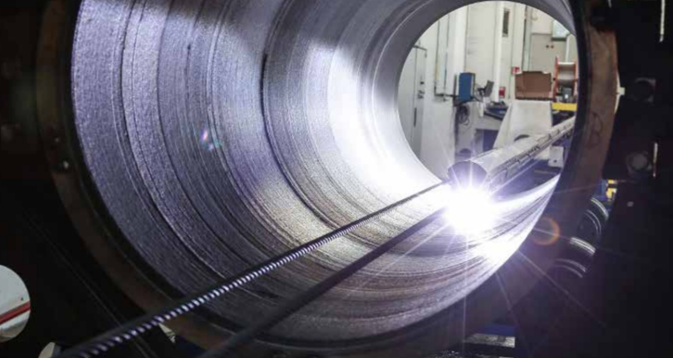
Horizontal cladding is performed using longitudinal twin TIGer technology, allowing two layers to be applied in a single run. CNC-controlled systems with integrated pre-heating and cooling devices guarantee consistent quality along the internal or external surfaces of long products such as pipes. Real-time monitoring through dual cameras ensures precision during welding operations.
Vertical claddings
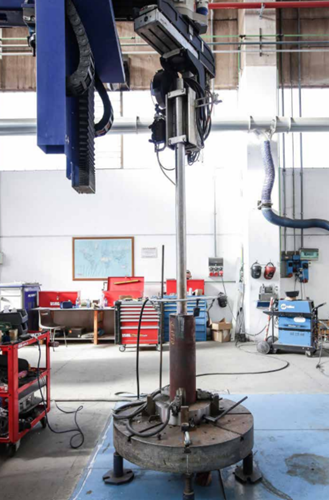
Vertical cladding is performed using SPXCNC TIGer equipment, which employs an endless rotating head. This design allows the workpiece to remain stationary on the ground while the welding torch rotates around it. The innovation makes it possible to clad even highly asymmetrical components. The equipment can handle internal diameters as small as 38 mm and product lengths up to 2,000 mm, offering flexibility across a wide range of applications.
Not sure which weld overlay alloy or process is right for your application?
From nickel-based alloys to wear-resistant overlays, M.E.G.A. helps engineers choose the most suitable solution for demanding environments.
Why is weld overlay used in industrial components?
Industrial equipment operating in harsh environments often suffers from:
- corrosion
- erosion
- cavitation
- abrasion
- high temperature degradation
Weld overlay is widely used to protect critical components and extend their operational life.
Instead of replacing entire piping systems or pressure components, weld overlay enables manufacturers to:
- repair worn surfaces
- enhance corrosion resistance
- improve wear resistance
- extend service life
This approach significantly reduces:
- equipment downtime
- maintenance costs
- material consumption
Industries and typical applications
Weld overlay technology is used across many industries where components must withstand extreme conditions.
The most common sectors include:
Oil and Gas
One of the largest users of weld overlay.
Typical applications include:
- subsea pipelines
- cladded pipes
- pressure vessels
- flowline components
- corrosion-resistant weld overlay flanges
Petrochemical and refining
Processing units operate with highly corrosive chemicals and high temperatures.
Overlay welding is used for:
- reactor vessels
- piping systems
- refinery fittings
Offshore and subsea systems
Subsea equipment must withstand:
- saltwater corrosion
- high pressure
- abrasive particles
Typical components include:
- subsea manifolds
- piggable pipeline fittings
- clad pipes and connectors.
Power generation
Weld overlay protects components exposed to:
- high temperatures
- steam erosion
- aggressive chemical environments
Typical applications:
- heat exchangers
- turbine components
- boiler piping systems
Nuclear industry
High-integrity materials and corrosion resistance are essential.
Overlay welding is often used for:
- nuclear piping components
- pressure vessels
- reactor cooling systems.
Materials used for weld overlay
The choice of overlay material is critical because it determines the component's final corrosion and wear resistance, as well as its mechanical performance. Below are some of the most commonly used alloys in weld metal overlay applications.
Nickel-based alloys
Nickel alloys provide excellent corrosion and high-temperature resistance.
Common materials include:
- Alloy 625 weld overlay (Inconel 625) - Widely used for subsea pipelines and offshore components due to its exceptional resistance to chloride corrosion and stress corrosion cracking.
- Incoloy 825 - Excellent resistance to sulfuric and phosphoric acids.
- Hastelloy C276 and C22 - High resistance to oxidizing and reducing environments.
Cobalt-based alloys
Cobalt alloys provide exceptional wear resistance.
Examples include:
- Stellite
These materials are ideal for:
- valve seats
- turbine components
- high-wear applications.
Carbide-based overlays
For extreme abrasion resistance, carbide overlays are often used.
The most common example is:
- tungsten carbide weld overlay
These coatings are widely applied in:
- mining equipment
- drilling tools
- material handling systems
Hardfacing as a welding process
In addition to corrosion-resistant cladding, hardfacing is a specialized welding process used to deposit wear-resistant materials onto a component’s surface.
Hardfacing differs from traditional weld overlay in its primary objective:
- Weld overlay (cladding) → corrosion protection
- Hardfacing → wear and abrasion resistance
Key characteristics of hardfacing:
- Deposition of hard, wear-resistant alloys (often cobalt- or carbide-based)
- Designed to extend component life in high-abrasion or erosion environments
- Applicable to both new components and refurbishment of worn parts
Typical applications:
- Valve internals and seats
- Pump components
- Drilling and mining tools
- Flow control equipment exposed to solid particles
Weld overlay vs cladding
Although the terms are often used interchangeably, there are important differences between weld overlay and cladding.
Weld overlay
- Deposited through welding processes
- Metallurgically bonded to the base metal
- Typically applied in multiple weld passes
- Can be applied internally or externally
Cladding
- Often applied during manufacturing through rolling or explosion bonding
- The corrosion-resistant layer is bonded to the base plate before fabrication
- Common in clad pipes and plates
Key differences
|
Feature |
Weld Overlay |
Cladding |
|
Manufacturing stage |
Applied after component fabrication |
Applied during plate production |
|
Flexibility |
High – can be applied to complex geometries |
Limited to plates or simple shapes |
|
Repair capability |
Excellent for repairs and upgrades |
Generally not repair-oriented |
Because of its flexibility, weld overlay is often the preferred solution for complex piping components, fittings, flanges, and forgings.
Why choose M.E.G.A. for weld overlay solutions
Thanks to decades of experience in the design and production of pipes, fittings, flanges, and forged components, M.E.G.A. combines advanced weld overlay technologies with deep metallurgical expertise. The company applies corrosion-resistant or wear-resistant alloys onto structural base materials to achieve the optimal balance between mechanical strength, corrosion resistance, and cost efficiency.
Operating in sectors where reliability is essential—such as oil & gas, petrochemical, offshore, subsea, power generation, and nuclear industries—M.E.G.A. provides engineered solutions tailored to each project. Automated welding technologies and strict quality control procedures ensure consistent overlay thickness, low dilution rates, and excellent metallurgical bonding.
Weld overlay can be applied to a wide range of components, including pipes, flanges, fittings, and forgings, enabling the production of high-performance parts capable of withstanding aggressive environments and extending equipment service life.
With integrated manufacturing capabilities, advanced welding systems, and comprehensive testing procedures, M.E.G.A. delivers reliable weld overlay solutions that meet the highest industry standards.
Contact our technical team today to discuss your project requirements and discover how M.E.G.A. weld overlay solutions can enhance the performance and longevity of your components.