


Offshore Pipe Fittings: Critical Applications, Materials, and Why Custom Engineering Wins
Offshore and subsea piping systems operate where failure is not an option: a leaking fitting on a platform deck is a safety incident, and a failed connection on a subsea tie-in can mean a multi-million-dollar intervention with a remotely operated vehicle. This is why so many offshore projects, from oil and gas platforms to emerging hydrogen and offshore wind infrastructure, specify pipe fittings that are engineered around the project.
Working on a subsea tie-in, platform piping, or floating infrastructure project? Review your fitting specification with M.E.G.A.'s engineering team before FEED closes.
Why offshore environments push pipe fittings to their limits
Offshore piping is exposed to a combination of stresses that rarely occur together onshore. Understanding them is the first step in specifying the right fitting:
- High and cyclic pressure — subsea flowlines and platform risers see pressure cycling from start-up, shut-in, and pigging operations, which drives fatigue at every geometric discontinuity, especially elbows and tees.
- Chloride-rich, corrosive environments — seawater immersion and splash-zone exposure accelerate corrosion in materials that would be adequate onshore.
- Vibration and dynamic loading — risers, jumpers, and topside piping are subject to wave-induced and mechanical vibration that standard catalog fittings are not always rated for.
- Restricted access for maintenance or repair — a fitting on a subsea manifold cannot be swapped out over a weekend; every component has to be right the first time.
- Extreme or combined temperatures — from cryogenic LNG service to high-temperature process lines, sometimes on the same platform.
None of these conditions are exotic on their own. What makes offshore projects demanding is that fittings frequently have to satisfy several of them at once, which is exactly the scenario where a standard, off-the-shelf fitting reaches the edge of its rated envelope.
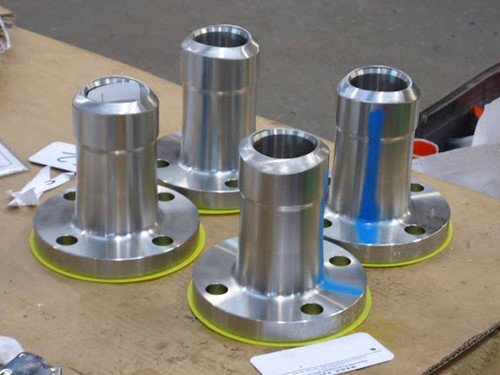
Critical offshore applications where custom fittings are non-negotiable
Certain offshore applications leave little room for standard components. These are the situations where engineering teams typically turn to a custom-fitting partner rather than a catalog.
Subsea pipelines and tie-ins
Subsea tie-in packages rely on fittings such as piggable wyes and anchor flanges, typically validated by finite element analysis (FEA). Many are supplied with corrosion-resistant alloy (CRA) cladding instead of solid exotic material, controlling cost without compromising integrity. Anchor flanges are used to restrain pipeline movement and absorb the axial forces generated by pressure and temperature variation, a requirement that is far more critical subsea, where a pipeline cannot simply be re-tensioned by a maintenance crew.
Offshore platforms and FPSOs
Topside piping on fixed platforms and floating production units combines high-pressure process lines with strict weight and space constraints. That is why fittings are frequently specified with flanged connections engineered to reduce installation cost and improve fatigue resistance rather than standard weld geometries.
Offshore wind and hydrogen-adjacent infrastructure
At pressures up to 700 bar (and higher in testing) the margin for error on a hydrogen fitting is effectively zero, which is exactly the condition offshore wind substations and the emerging offshore hydrogen value chain are starting to introduce. High-pressure hydrogen service brings a real risk of hydrogen embrittlement, so fittings for this environment are increasingly specified in nickel-rich alloys, precisely because standard carbon steel is highly susceptible to hydrogen-induced cracking.
LNG and cryogenic service
Offshore LNG terminals and floating storage and regasification units (FSRU) combine cryogenic temperatures with the same access and safety constraints as any other offshore asset, which typically rules out standard fittings not rated for the full thermal cycle.
A fitting that is technically correct on paper but wasn't engineered for your specific combination of pressure, temperature, and access constraints is often where offshore project delays start. It is worth reviewing the application in detail before finalizing the material and geometry.
Contact our technical team to have a custom consultation
Materials engineered for harsh offshore environments
Material selection is usually the single most consequential decision in an offshore fitting specification, more than geometry, and often more than the fitting standard itself. The table below summarizes how material choice typically maps to offshore service conditions.
|
Material |
Typical offshore use case |
Why it is selected |
|
Carbon / low-alloy steel |
General service piping, non-corrosive process lines |
Cost-effective where corrosion and temperature loads are moderate |
|
Duplex / super duplex stainless steel |
Seawater-exposed lines, splash zone, firewater systems |
High resistance to chloride-induced pitting and stress corrosion cracking |
|
Nickel alloys — Inconel 625 |
Sour service, high-pressure hydrogen, subsea trees and flowlines, high-corrosion process streams |
High nickel-chromium-molybdenum content resists both aggressive corrosion and hydrogen embrittlement at high pressure |
|
Titanium and titanium alloys |
Extreme corrosion resistance applications, weight-sensitive topside piping |
Excellent corrosion resistance with a favorable strength-to-weight ratio |
|
CRA cladding / weld overlay |
Piggable wyes, large-bore fittings, subsea tie-ins |
Delivers corrosion resistance of the alloy on the wetted surface without the cost of a solid exotic-alloy component |
Inconel 625 in particular has become a reference material for offshore and hydrogen-adjacent projects precisely because it performs on two fronts at once: it resists the chloride and sulfideattack typical of sour offshore production, and it maintains ductility in high-pressure hydrogen service where standard carbon steels are prone to embrittlement.
Choosing between duplex, super duplex, and a nickel alloy like Inconel 625 is a decision worth confirming with an engineering team before it is locked into a project specification: the wrong choice in either direction means overpaying or under-protecting the line. Contact us to have a personalized consultation.
Elbows, tees, reducers, caps: when a standard shape isn't a standard fitting
A useful distinction for procurement and engineering teams: the geometry of a fitting (elbow, tee, reducer, cap) and the way it is manufactured are two different questions. Offshore projects very often need the same basic shapes used in any piping system, but built to a specification that no catalog part number covers.
Elbows (45° and 90°)
A 45° or 90° elbow looks like the simplest shape on the drawing, until a tight bend radius turns into the first erosion point in a line carrying sand-laden production fluid or two-phase flow. Elbows are used to change the direction of flow, and long-radius elbows are generally preferred over short-radius in offshore and process piping precisely because the larger bend radius reduces friction losses and erosion.
Tees (equal and reducing)
Every branch connection is a potential weak point, which is why the tee variant matters as much as the tee itself. Tees are used to create branch lines: in an offshore context, they are frequently specified as reducing tees to transition to a smaller branch size, or as barred, flow, or target tees, purpose-built variants engineered to allow safe pig passage or handle erosive flow at the branch.
Reducers (concentric and eccentric)
Reducers are used to change pipe diameter along a line, and eccentric reducers are critical in horizontal suction lines, where a concentric reducer would create an air pocket at the top of the pipe; the offset geometry of an eccentric reducer keeps the pipe invert level and prevents that pocket from forming. A detail that matters more, not less, on an offshore platform where cavitation is harder to diagnose and fix.
Caps and plugs
A cap or plug is often the last component specified on a line, and the easiest one to under-specify accidentally. Used to seal the end of a pipe or a branch connection, whether permanently or for a future tie-in, caps and plugs still have to match the same pressure rating and material as the rest of the system: a mismatched cap is a weak point in an otherwise correctly engineered line.
Custom fitting vs. standard catalog fitting: what actually changes offshore
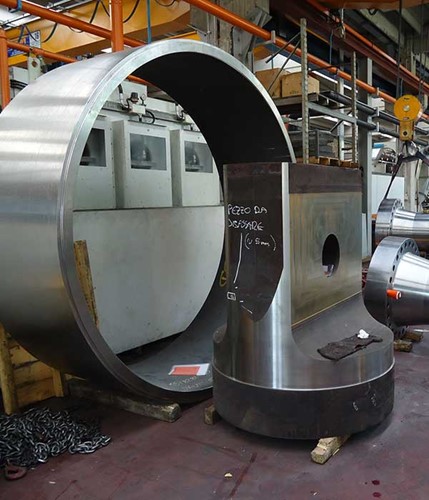
Custom means that the fitting is engineered around the actual operating envelope of the project rather than the nearest available catalog size and rating. The comparison below summarizes what typically shifts when a project moves from a standard to a custom-engineered fitting.
|
Factor |
Standard catalog fitting |
Custom-engineered fitting |
|
Material range |
Limited to common stocked grades |
Any steel grade, plus duplex, super duplex, nickel alloys (e.g., Inconel 625) and titanium, on request |
|
Size range |
Bound by standard dimensional tables |
Manufactured up to 80 in. for special fittings and up to 48 in. / 12 m for forged seamless pipes |
|
Engineering validation |
Generic rating tables |
Project-specific FEA / FEM verification of wall thickness, radii, fatigue and pressure integrity |
|
Traceability & documentation |
Standard mill certificates |
Full material traceability, NDE reports (PT, UT, MT), hydrostatic test records, PMI where required |
|
Lead time vs. risk |
Fast, low risk for non-critical, standard-envelope service |
Longer lead time, but engineered specifically to avoid a field failure where repair access is limited or impossible |
Before finalizing a bill of materials for an offshore package, it is worth having M.E.G.A.'s engineering team review which components genuinely need a custom specification and which can safely remain standard.
Certifications and compliance for offshore fittings
Offshore projects add a layer of certification requirements beyond standard piping codes, because the fitting supplier's quality system is being vetted alongside the part itself. M.E.G.A.'s special and standard fittings are manufactured to the following framework of design and material codes:
|
Standard |
Scope |
|
ASME B31.1 / B31.3 / B31.4 / B31.8 |
Power piping, process piping, liquid and gas transportation piping systems |
|
ASME B16.5 / B16.11 / B16.47 |
Pipe flanges and flanged fittings, forged fittings, large-diameter steel flanges |
|
ASME Section VIII / API 6A |
Pressure vessels; wellhead and Christmas tree equipment |
|
DNV-ST-F101 / NORSOK M-650 |
Subsea pipeline systems; qualification of manufacturers for material fabrication |
|
EN 13480 / EN 10253 |
European standards for metallic industrial piping and butt-welding fittings |
|
ASME B31.12 |
Hydrogen piping and pipelines |
M.E.G.A. also holds quality and marine-specific certifications relevant to offshore procurement, including ISO 9001 and ISO 14001 (DNV), ISO 3834-2 (Bureau Veritas), Approval Certificate for Materials and BV Mode II Scheme (Bureau Veritas Marine), and Lloyd's Register approval, alongside PED and NORSOK M-650 qualification. The full, current list is maintained on the
M.E.G.A. certifications page — worth checking directly, since certification scope can be specific to product line and material grade.
Why offshore operators choose M.E.G.A.
M.E.G.A. S.p.A. has been forging fittings since 1962, with production sites in Italy, the USA, and Switzerland. For offshore projects specifically, three things tend to matter most:
- Fully in-house production — forging, machining, heat treatment, cladding and weld overlay (TIG, MIG, submerged arc), surface treatment, and NDE testing (PT, UT, MT) are all carried out internally, including destructive testing in M.E.G.A.'s own accredited laboratory, which shortens the chain of custody on a component that will be very difficult to inspect once installed.
- No fixed design limit — fittings and forgings are produced up to 80 in., and forged seamless pipes up to 48 in. and 12 metres, in any steel grade including duplex, super duplex, nickel alloys, and titanium.
- Engineering support from FEA through certification — every custom geometry can be validated by finite element analysis before manufacture, with full material traceability and testing documentation delivered alongside the finished part.
This is the combination that offshore projects tend to need most: a single accountable manufacturer for the engineering, the forging, and the certification, rather than a supply chain assembled from separate specialists.
Frequently Asked Questions
What makes offshore and subsea pipe fittings different from onshore fittings?
Offshore fittings typically combine higher pressure cycling, chloride-rich corrosion exposure, vibration, and restricted maintenance access in ways that rarely occur together onshore, which is why material grade, wall thickness, and certification requirements are usually higher even when the basic geometry — an elbow or a tee, for example — is the same.
Why is Inconel 625 used for offshore pipe fittings instead of standard stainless steel?
Inconel 625 resists both chloride-driven corrosion and hydrogen-induced embrittlement at high pressure, which makes it suitable for sour service, subsea trees, and hydrogen-adjacent applications where standard stainless steel or carbon steel would be at risk of premature failure.
Can M.E.G.A. supply piggable and misalignment fittings for subsea pipelines?
Yes, M.E.G.A. manufactures piggable wyes (symmetric and asymmetric), anchor flanges, and misalignment flanges rated for up to ±10° of pipeline misalignment, validated by FEA and compliant with ASME VIII, B31.4, B31.8, and DNV standards.
What certifications should I check before selecting an offshore fitting supplier?
At minimum, verify ISO 9001 and ISO 3834-2 quality certification, marine approval from a recognized class society (Bureau Veritas Marine or Lloyd's Register, for example), and compliance with the specific design code that applies to the application - ASME B31.3 for process piping, ASME B31.12 for hydrogen service, or DNV-ST-F101 for subsea pipelines.
Are custom offshore fittings still built to ASME B16.11 dimensions?
Often, yes. ASME B16.11 remains the dimensional reference for the base geometry of elbows, tees, reducers, and caps. What typically changes for offshore service is the material grade, wall thickness, certification package, and size, which can extend well beyond what a standard B16.11 catalog covers.
Talk to M.E.G.A. about your offshore fitting requirements
Offshore projects rarely fail because of one dramatic design error. More often, it is a fitting spec that was close enough on paper but not matched to the real operating envelope. Whether the application is a subsea tie-in, a platform riser, or an emerging hydrogen or offshore wind installation, M.E.G.A.'s engineering team can review the application before the material and geometry are locked in.
Contact M.E.G.A.'s technical sales team to discuss your offshore project requirements and request a quote for custom-forged fittings.