


TIG Welding Inconel 625
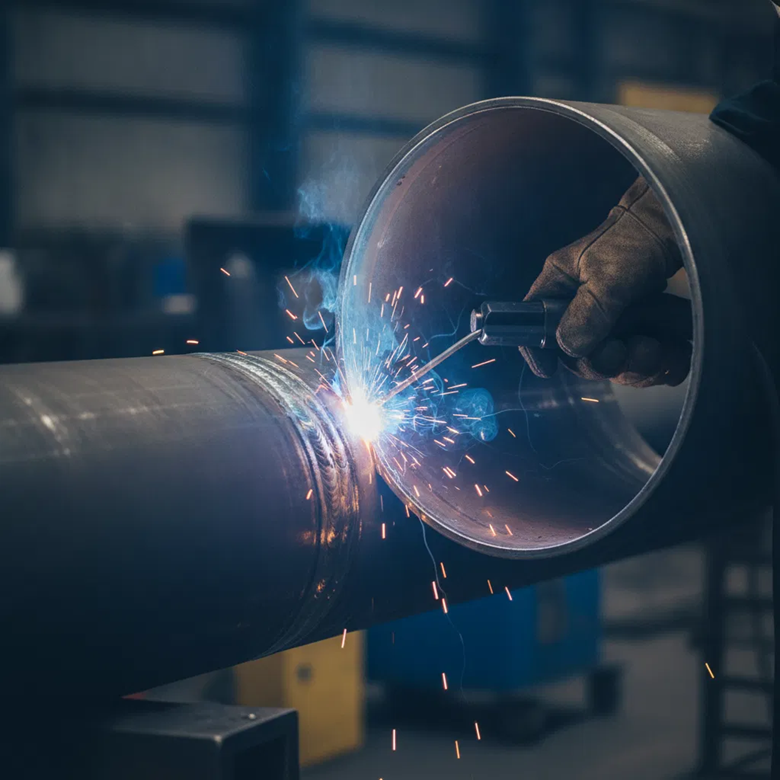
TIG (GTAW) is the reference welding process for depositing Inconel 625, and in practice, most pipeline and process components don't need to be solid Inconel 625: they need a TIG-applied Inconel 625 weld overlay bonded to a carbon or low-alloy steel base, which delivers the same corrosion and hydrogen-resistance on the wetted surface at a fraction of the material cost.
MEGA S.p.A. designs and produces this overlay in-house, on its own forged fittings, pipes, flanges and forgings, using a proprietary hot-wire TIG process.
Why TIG (GTAW) is the process that protects Inconel 625's corrosion resistance
Get the heat input wrong on Inconel 625, and the alloy's main selling point is the first thing to go: excessive heat promotes hot cracking and dilutes the deposited layer with the base metal, weakening the very corrosion resistance the alloy was specified for. Inconel 625 is a nickel-chromium-molybdenum alloy prized for corrosion and hydrogen-embrittlement resistance, but it is also sensitive to heat input in a way most carbon or stainless steels are not. This is why Gas Tungsten Arc Welding (TIG/GTAW) is the process most welding and metallurgical references point to for Inconel 625: it gives the operator precise, independent control over heat input, arc length and filler feed.
For fittings, pipes and forgings that need a corrosion-resistant layer rather than a solid nickel-alloy body, that same heat control becomes the deciding factor in weld-overlay quality: low dilution keeps the deposited Inconel 625 close to its full corrosion-resistant chemistry, instead of being diluted by the carbon steel underneath.
MEGA's hot-wire TIG process (Tiger)
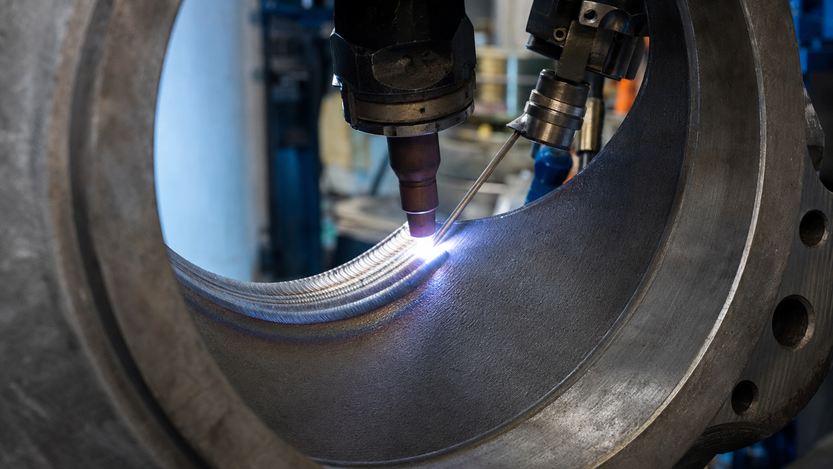
To apply Inconel 625 and other corrosion-resistant alloys at production scale, MEGA uses a special version of hot-wire TIG developed with Polysoude and called Tiger. Standard hot-wire TIG pre-heats the filler wire before it enters the weld pool; Tiger technology goes further, using two tungsten electrodes in a tandem configuration, each separately fed, whose two thermal sources join into a single arc. Because the resulting arc pressure is lower than in a classic tandem configuration, MEGA can run higher current intensities, which means higher travel speeds and higher deposit rates, while still achieving lower dilution rates than conventional GTAW overlay.
- Horizontal cladding (Longitudinal Twin Tiger): CNC-managed equipment that clads internal and external surfaces of pipes and long products, depositing two layers in a single pass of the welding head, with dual-camera real-time monitoring of the weld pool.
- Vertical cladding (SPXCNC Tiger): CNC-managed equipment with a rotating head, used for highly asymmetrical parts that are easier to clad standing on the ground than rotating on a lathe.
- Integrated, software-controlled pre-heating and cooling on both lines, to keep the thermal cycle, and therefore the metallurgy of the Inconel 625 layer, consistent from the first pass to the last.
Critical applications where TIG-welded Inconel 625 solves a real engineering problem
Inconel 625 is rarely specified out of caution; it is specified because a particular combination of pressure, corrosion, and temperature would compromise a standard material. The table below summarizes where this shows up in practice, and the specific problem TIG-applied Inconel 625 addresses in each case.
|
Sector |
Technical problem |
How TIG-applied Inconel 625 solves it |
|
Offshore & subsea oil and gas |
Subsea tie-ins, piggable wyes and seamless pipes combine chloride-rich seawater exposure with sour (H2S) production fluids - a combination that drives both pitting corrosion and stress-corrosion cracking in standard steels. |
A TIG-applied Inconel 625 CRA overlay on the wetted surface resists chloride and sulfide attack without the cost of a solid nickel-alloy component - MEGA supplies this overlay option on piggable wyes and seamless pipes for offshore and subsea service. |
|
Hydrogen infrastructure |
High-pressure hydrogen storage and refuelling (up to 700 bar, and higher in testing) allows atomic hydrogen to diffuse into standard carbon steel and cause hydrogen embrittlement - a risk of sudden, brittle failure under pressure. |
Inconel 625's high nickel-chromium content inhibits hydrogen diffusion into the crystal lattice; MEGA's TIG/GTAW process allows this chemistry to be applied precisely where the hydrogen exposure is highest, or used as the solid material for the most critical components. |
|
Chemical processing |
Heat transfer, distillation and mass-separation lines in chemical plants routinely carry aggressive, corrosive media that exceed the resistance of standard stainless steel. |
Rather than manufacturing an entire fitting in a special alloy, MEGA's weld-overlay technology allows a corrosion-resistant layer - including Inconel 625 - to be TIG-deposited onto a stainless or carbon steel base, containing material cost to the surfaces actually exposed to the process fluid. |
Across all three, the underlying logic is the same: the problem is rarely solved by using a stronger material everywhere, but by placing the right corrosion-resistant chemistry exactly where the operating envelope requires it, which is precisely what a controlled TIG overlay process is built to do.
How MEGA controls the variable that makes or breaks an Inconel 625 overlay
An Inconel 625 overlay is only as good as its most inconsistent pass: a single section with excess dilution or an uneven thermal cycle can leave a weak point in an otherwise corrosion-resistant surface. MEGA's cladding division was set up specifically to industrialize weld overlay on pipeline components, applying corrosion-resistant alloys onto a range of base steels via TIG/GTAW and related arc-welding processes. The table below lists the CRA materials MEGA can apply this way - Inconel 625 is one of several, selected according to the specific corrosion or temperature challenge.
|
Overlay material |
UNS / designation |
Typical role |
|
Inconel 625 |
UNS N06625 |
Chloride and sulfide corrosion, hydrogen-adjacent service, high-temperature process lines |
|
Incoloy 825 |
UNS N08825 |
General corrosion resistance in acidic and chloride-bearing environments |
|
Hastelloy C276 |
UNS N10276 |
Severe reducing and oxidizing media, sour service |
|
Hastelloy C22 |
UNS N06022 |
Broad corrosion resistance, including oxidizing chlorides |
|
Stellite (Co-Cr alloys) |
- |
Wear and erosion resistance, high-temperature hardness |
|
Stainless steel, series 300/400 |
- |
General corrosion resistance where full nickel-alloy performance is not required |
These layers can be deposited on carbon-manganese steel, low-alloy steel, high-alloy steel, martensitic stainless steel, or ferritic stainless steel base material. In production, MEGA applies TIG/GTAW weld overlay to pipes up to 12 metres in length, forgings, fittings and flanges, as well as specific subsea components such as buckle arrestors and barred tees - in addition to butt-welding and pre-fabricating welded spools.
In short: solid Inconel 625 vs. TIG-applied Inconel 625 overlay
- Solid Inconel 625 component: the entire part is machined or forged from the nickel alloy - justified when the whole section is exposed to the aggressive condition, or when a code requires it.
- TIG-applied Inconel 625 weld overlay: a corrosion-resistant layer is deposited by GTAW onto a carbon or low-alloy steel base - MEGA's usual approach for pipes, fittings, flanges and forgings, where only the wetted surface needs the alloy's resistance.
- Both routes start from the same TIG process discipline: controlled heat input and low dilution to preserve the alloy's corrosion chemistry, whether it forms the whole part or just its exposed surface.
Certifications and why choose MEGA for TIG-Welded Inconel 625 components
Specifying a TIG/Inconel 625 weld overlay is also a decision about the supplier's quality system, since the alloy layer is only as reliable as the process and the inspection behind it. MEGA's welding and cladding activity is certified under a framework that specifically covers overlay work, not just base fitting manufacture.
|
Standard |
Scope |
Issuing body |
|
UNI EN ISO 3834-2 |
Design and production of welded forged fittings and special welded fittings in ferrous and non-ferrous material with overlay |
Bureau Veritas |
|
API 5LD |
Cladding of pipes |
API |
|
NORSOK M-650 |
Material qualification (incl. corrosion-resistant and duplex grades) |
MRC Global |
|
UNI EN ISO 9001 |
Quality management system, MEGA's Italian and US sites |
DNV |
|
PED 2014/68/EU |
Quality system for pressure equipment |
TUV |
|
ASME B31.1 / B31.3 / B31.4 / B31.8, Sect. IX |
Design codes and welding qualification |
ASME / TUV |
MEGA also holds marine and offshore approvals relevant to weld-overlay supply, including Bureau Veritas Marine, Lloyd's Register, and DNV manufacturer approval.
Beyond certification, three things tend to matter most for TIG/Inconel 625 weld-overlay projects specifically:
- Fully in-house production - forging, machining, heat treatment, TIG/GTAW weld overlay, and non-destructive testing (PT, UT, MT) are carried out internally, including destructive testing in MEGA's own accredited laboratory, shortening the chain of custody on a corrosion-resistant layer that is difficult to inspect once the component is installed.
- A dedicated cladding division - producing overlay on pipes up to 12 m, forgings, fittings and flanges, rather than treating cladding as a subcontracted, occasional process.
- Six decades of production since 1962 across Oil & Gas, petrochemical, offshore, subsea and power-plant sectors, which is the base of experience that informs which CRA grade - and which TIG parameters - fit a given application.
Talk to MEGA About Your TIG-Welded Inconel 625 Requirement
Whether a component needs a solid Inconel 625 body, a TIG-applied weld overlay, or a different corrosion-resistant alloy, the decision is easiest to get right before the material specification is locked in. MEGA's engineering and cladding teams can review the application, the base material, and the certification package your project requires.
Contact MEGA's technical sales team to discuss your TIG welding and weld-overlay requirements for Inconel 625 components.
Frequently Asked Questions
Is TIG welding required to apply Inconel 625, or can other processes be used?
TIG (GTAW) is the reference process because of its precise heat control and low dilution, which are both important for preserving Inconel 625's corrosion resistance. MEGA also uses MIG/GMAW and submerged-arc welding for other materials and processes, but for a controlled, low-dilution Inconel 625 overlay, hot-wire TIG - MEGA's Tiger process - is the preferred method.
What's the difference between a solid Inconel 625 component and a TIG-applied Inconel 625 weld overlay?
A solid component is entirely machined or forged from Inconel 625, which is justified when the full cross-section must resist the aggressive condition. A weld overlay deposits a corrosion-resistant Inconel 625 layer, typically a few millimetres thick, onto a carbon or low-alloy steel base via TIG - delivering the same wetted-surface resistance at a lower material cost. This is the approach MEGA supplies for pipes, fittings, flanges and forgings through its cladding division.
Which certifications should I check for a TIG/Inconel 625 weld-overlay supplier?
At minimum, verify ISO 3834-2 (welded fittings with overlay) and API 5LD (cladding of pipes), together with the design code that applies to the project - for example the ASME B31 series for process and pipeline piping, or NORSOK M-650 for subsea material qualification.
What sizes and components can MEGA TIG-weld or clad with Inconel 625?
MEGA applies TIG/GTAW weld overlay to pipes up to 12 metres in length, forgings, fittings and flanges, and specific subsea components such as barred tees and buckle arrestors. Forged fittings are produced from 1/8 inch up to 6 inches, and forged seamless pipes from 2 inches up to 48 inches, in the base steel grade and overlay alloy the project requires.
Contact MEGA's technical sales team to discuss your TIG welding and weld-overlay requirements for Inconel 625 components.