


Tungsten Carbide Weld Overlay: Properties, Applications and Limits
A tungsten carbide weld overlay is a wear-resistant layer made of hard tungsten carbide (WC) particles held in a tougher metal matrix, deposited by welding onto a steel component. The steel carries the mechanical load, while abrasion and erosion are taken by the carbide-rich surface. It is the hardfacing option engineers specify when sand, slurry, rock or other solids wear a part out faster than any homogeneous alloy can withstand.
The general principles of the process are covered in the M.E.G.A. complete guide to the weld overlay process.
What is tungsten carbide weld overlay?
Tungsten carbide weld overlay is a metal matrix composite deposit: hard carbide particles are distributed in a softer, tougher binder alloy and fused to the base metal by an arc or another heat source. The bond is metallurgical, not mechanical, which is the main difference from sprayed coatings.
The two phases play different roles:
- Tungsten carbide particles provide the hardness. They are among the hardest materials used in industrial wear protection and resist cutting and gouging by abrasive solids.
- The matrix, typically nickel-based or iron-based, holds the particles in place, absorbs part of the impact energy and provides the bond to the steel substrate.
This is why a tungsten carbide overlay behaves differently from a "hard" alloy such as a martensitic steel or a cobalt-chromium alloy. The wear surface is not uniformly hard: the matrix wears first, the carbides stand proud of the surface and take the abrasive load. Performance depends on carbide content and distribution, and on how well the matrix holds the particles in place.
Key facts about tungsten carbide:
- Melting point of tungsten carbide: approximately 2,870 °C (5,200 °F), far above that of the steel substrate
- Particle hardness typically above 2,000 HV, depending on carbide type
- Function: protection against abrasion and erosion, not a corrosion-resistant barrier on its own
Carbide type and matrix: what really drives wear performance
The difference in tungsten carbide usually comes from three variables that generic datasheets rarely spell out: the type of carbide, the matrix alloy and the carbide content.
Tungsten carbide types
- Cast and crushed (fused) tungsten carbide: a WC/W2C eutectic, crushed into angular particles. Very hard, widely used, but the sharp edges can act as crack initiators.
- Spherical cast tungsten carbide: the same eutectic in spherical form. Without sharp edges, particles are less prone to fracture, and published studies generally rank it among the most wear-resistant options.
- Monocrystalline (macrocrystalline) tungsten carbide: single-phase WC crystals, tougher and more stable under the heat of welding, at slightly lower hardness than the cast grades.
Matrix alloys
The matrix decides how the overlay behaves around the carbides. Nickel-based matrices are preferred where the abrasive medium is also chemically aggressive, such as produced water or process slurries, and where a more ductile binder helps limit cracking. Iron-based matrices are the cost-efficient choice for dry abrasion, as in mining, cement or bulk handling.
Carbide content
Carbide content is the third lever. More carbide mainly means more wear resistance, up to the point where the matrix can no longer hold the particles and the deposit becomes brittle. The right balance depends on the service conditions, which is why a tungsten carbide overlay should be specified starting from the actual wear mechanism.
GMAW, PTA or Laser: how to deposit tungsten carbide without losing the carbides
The best carbide on paper is worthless if it dissolves in the weld pool. Tungsten carbide cannot be welded the way a solid wire alloy is: the particles must reach the surface intact. Each deposition process manages this trade-off differently.
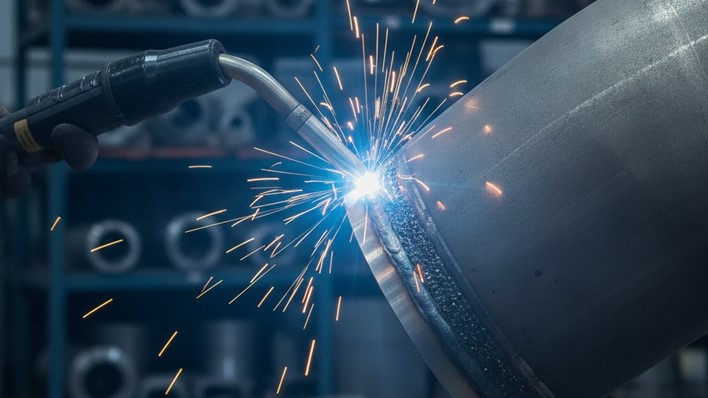
- GMAW with tungsten carbide flux-cored wire: a tubular wire carries the carbide particles inside a metal sheath, which melts to form the matrix. It offers good deposition rates, works well on large surfaces and complex geometry, and fits the automated welding systems already used for cladding.
- Plasma transferred arc (PTA): carbide powder is fed into a plasma arc. Heat input and dilution can be kept low, at the cost of lower productivity and more specialised equipment.
- Laser cladding: very low dilution and a narrow heat-affected zone, suited to thin, precise layers on high-value parts, with higher equipment and operating costs.
- Spray and fuse: a powder blend is sprayed and then fused with a torch, generally used for small components and thin coatings.
Whatever the process, the critical parameter is heat input. Too much heat partially dissolves the carbides into the matrix, forms brittle phases and reduces the carbide fraction that actually reaches the surface. With insufficient heat, the deposit does not fuse properly with the base metal. Controlled parameters and qualified procedures matter more here than with most other overlay alloys.
Not sure which deposition process suits your part? Send the M.E.G.A. technical team your drawing and operating conditions: they will tell you whether GMAW overlay with tungsten carbide cored wire is the right fit, and which areas of the component it should cover.
Tungsten carbide vs chromium carbide, stellite and inconel 625: which overlay fits your wear problem?
The right overlay depends on what is destroying the surface: solid particles, chemistry, heat or impact. The most common mistake is specifying a hardfacing alloy for a corrosion problem, or a corrosion-resistant alloy for an erosion problem.
Tungsten carbide wins where solid particles do the damage: sand, ore, slurry, cuttings. Where the threat is chlorides, sour gas or high-temperature oxidation, a corrosion-resistant overlay such as Inconel 625 weld overlay is the right tool. Where a component must resist both, the solution is usually a combination of materials or zones rather than a single alloy, and is worth discussing with an overlay specialist before the specification is frozen.
Where tungsten carbide weld overlay pays off: industries and components
Tungsten carbide weld overlay delivers the most value on components where erosion is concentrated in a predictable area and where replacement means stopping a line. Typical sectors include:
- Oil and gas: sand-laden production flows, which erode the extrados of elbows, tee branches and wyes where the flow changes direction.
- Mining and mineral processing: slurry pipelines and transfer components handling ore and tailings.
- Dredging and bulk material handling: pipes and fittings conveying sand, gravel and abrasive solids.
- Cement and power generation: lines transporting clinker, ash and pulverised fuel.
In piping systems, wear rarely spreads evenly. It concentrates where the flow changes direction or velocity: the outer radius of an elbow, the branch of a tee, the junction of a wye. These are the areas where a localised tungsten carbide overlay can extend service life without upgrading the whole line to a more expensive material.
If your maintenance records show the same fitting failing in the same position, that location is the first candidate for a targeted overlay.
Why engineers specify tungsten carbide overlay: five advantages
Fewer replacements and shorter shutdowns are the result engineers look for. Compared with replacing worn parts or upgrading to solid wear-resistant materials, a tungsten carbide overlay offers:
- Longer service life in abrasive service, which means fewer shutdowns and spare parts.
- Protection where it is needed: the overlay goes only on the surfaces that wear, while the base component stays in a standard, weldable steel.
- Metallurgical bond: unlike sprayed coatings, the deposit is fused to the substrate and does not rely on mechanical adhesion.
- Design freedom: overlay thickness, carbide type and matrix can be tuned to the service conditions.
- Repairability: worn areas can often be restored by re-applying the overlay instead of scrapping the component.
Tungsten carbide weld overlay by M.E.G.A.: wear and corrosion protection from one supplier
M.E.G.A. applies tungsten carbide weld overlay using GMAW with tungsten carbide flux-cored wire, within its dedicated cladding division, part of M.E.G.A.'s welding services. The same division performs corrosion-resistant overlays in nickel alloys, cobalt-chromium alloys and stainless steels. Engineers can therefore discuss wear protection and corrosion protection with a single supplier, and choose the right overlay for each area of the component.
Because overlay is integrated into M.E.G.A.'s manufacturing, the component and its protection are produced under one quality system:
- Design and FEA analysis of special fittings and forgings
- In-house heat treatment and machining
- Non-destructive testing (PT, UT, MT) and destructive testing, including chemical, tensile, impact, micrographic and macrographic tests, in an internal laboratory accredited to ISO/IEC 17025 by Accredia
- Welding quality management certified to UNI EN ISO 3834-2
- Complete technical documentation for each supply
If a fitting or forging in your line is wearing out faster than planned, send us the drawing, the operating conditions and the wear pattern you are seeing. The M.E.G.A. technical team will assess whether a tungsten carbide overlay is the right solution and how to apply it to your component.